Kindergarten Readiness Checklist
Pick the areas, add your own items and notes lines, then print a tick-box checklist built from the CDC milestones for age 5, or download it as a CSV.
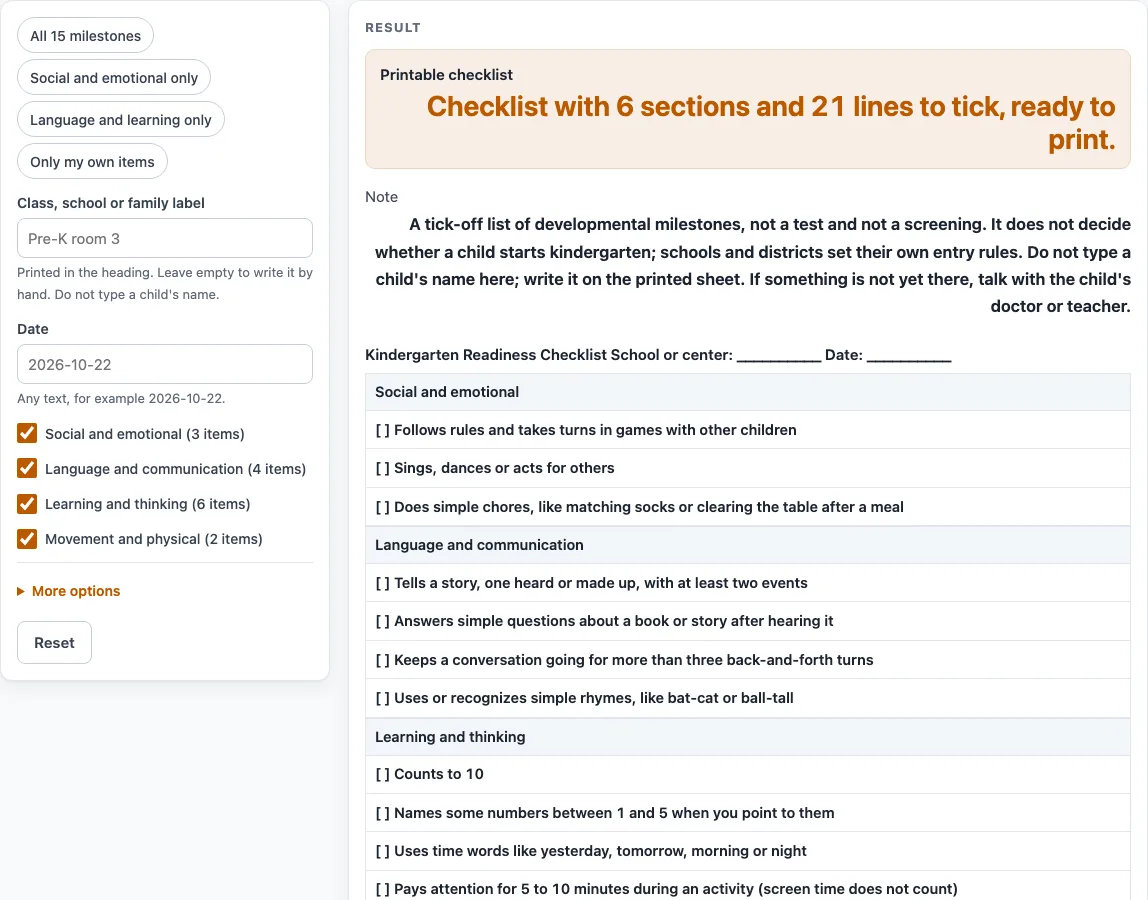
How to use the Kindergarten Readiness Checklist
- Type a class, school or family label and a date if you want them printed in the heading. Both are optional. Do not type a child’s name. Write names by hand on the printed sheet.
- Keep the milestone areas you want as tick boxes: Social and emotional (3 items), Language and communication (4 items), Learning and thinking (6 items) and Movement and physical (2 items). Turn off any area you do not need.
- To start from a ready set, pick a preset: All 15 milestones, Social and emotional only, Language and learning only, or Only my own items.
- Open More options. Under ‘Your own items (optional)’, type one item per line, up to 10.
- Set ‘Number of notes lines’ from 1 to 20. The default is 4.
- Check the ‘What to do if something is not yet there’ setting so the closing section suits how you plan to use the sheet.
- Print the sheet. To get the same content as a spreadsheet file, press the CSV button.
The printed sheet has a heading, your tick boxes, your own items as an extra section, blank notes lines and a short closing section. Your typed labels and own items are part of the page address, so anyone you send the link to will see them.
What should a child know before kindergarten?
The checklist answers this with the CDC’s developmental milestones for age 5, which are skills that most children (75% or more) can do by that age. No national list sets what a child must know before starting kindergarten, so entry rules are set by each state or school district.
The 15 items fall into four areas. Social and emotional items include following rules and taking turns in games with other children, singing, dancing or acting for others, and doing simple chores such as matching socks or clearing the table. Language items include telling a story with at least two events, answering simple questions about a book after hearing it, keeping a conversation going for more than three back-and-forth turns, and using or recognizing simple rhymes like bat-cat. Learning and thinking items include counting to 10, naming some numbers from 1 to 5 when pointed to, using time words like yesterday, tomorrow, morning and night, paying attention for 5 to 10 minutes during an activity (screen time does not count), writing some letters in their name, and naming some letters when pointed to. Movement items are buttoning some buttons and hopping on one foot.
What are the CDC milestones for a 5 year old?
The CDC’s “Milestones by 5 Years” page lists what most children can do by age five. This tool uses 15 of those milestones, worded in short form, and sorts them into four areas. Tick an item when you have seen the child do it, and leave it blank when you have not yet seen it.
The CDC does not use the word “readiness” on that page. Its materials are also not a substitute for standardized, validated developmental screening. Use the list to note what a child is doing, not to score the child.
Sources (checked 18 October 2026): cdc.gov
Worked examples
| Input | Result |
|---|---|
| 21 lines | 6 sections, 21 lines |
| 16 lines | 4 sections, 16 lines |
| 21 lines | 7 sections, 21 lines |
Calculated by the tool above; open it with the same values to see each step.
Frequently asked questions
Is there an official kindergarten readiness test?
No national test decides who starts kindergarten. Each state or school district sets its entry rules and any readiness or screening assessment, so check with the school. This checklist is a tick-off list of milestones, not a test or a screening.
What if my child is not yet doing some of these things?
A “not yet” means the child develops at a different speed. Share the list with the child’s doctor or teacher and ask about developmental screening. If concerns remain, ask for a specialist referral and contact your state or territory early intervention program (cdc.gov/FindEI).
Can I add my own items to the checklist?
Yes. Under More options, type your own items in ‘Your own items (optional)’, one per line, up to 10. They print as an extra section after the four milestone areas. If you enter more than 10 lines, the extra lines are dropped with a warning.
Is the checklist saved or uploaded?
No. Nothing is uploaded or saved. Typed labels and your own items stay in your browser, but they are included in the page address when you share the link.
Can I use the printed sheet in materials I sell?
Yes. The printed sheet is yours to use, including in classroom materials you sell or share on sites such as TpT, Etsy or KDP. No credit is needed.
Do I need to sign up to use it?
No. The tool is free, requires no sign-up, and works on a phone.
Related tools
- Preschool Schedule: use it to plan a daily routine for children in preschool.
- Daily Lesson Plan Template: use it to outline one day of teaching.
- Kindergarten Lesson Plan Template: use it to plan lessons for a kindergarten class.
- Parent Teacher Conference Form: use it to prepare notes for a meeting with a child’s teacher.
- Report Card Comments: use it to write end-of-term comments on a child’s progress.
- School and daycare admin: use it for paperwork and record keeping in a school or daycare.