Nanny Cost vs Daycare Calculator
Enter the daycare price and the nanny wage and hours to see the yearly cost of each, the difference, and how many children or hours make them equal.
How to use the Nanny vs Daycare Cost Calculator
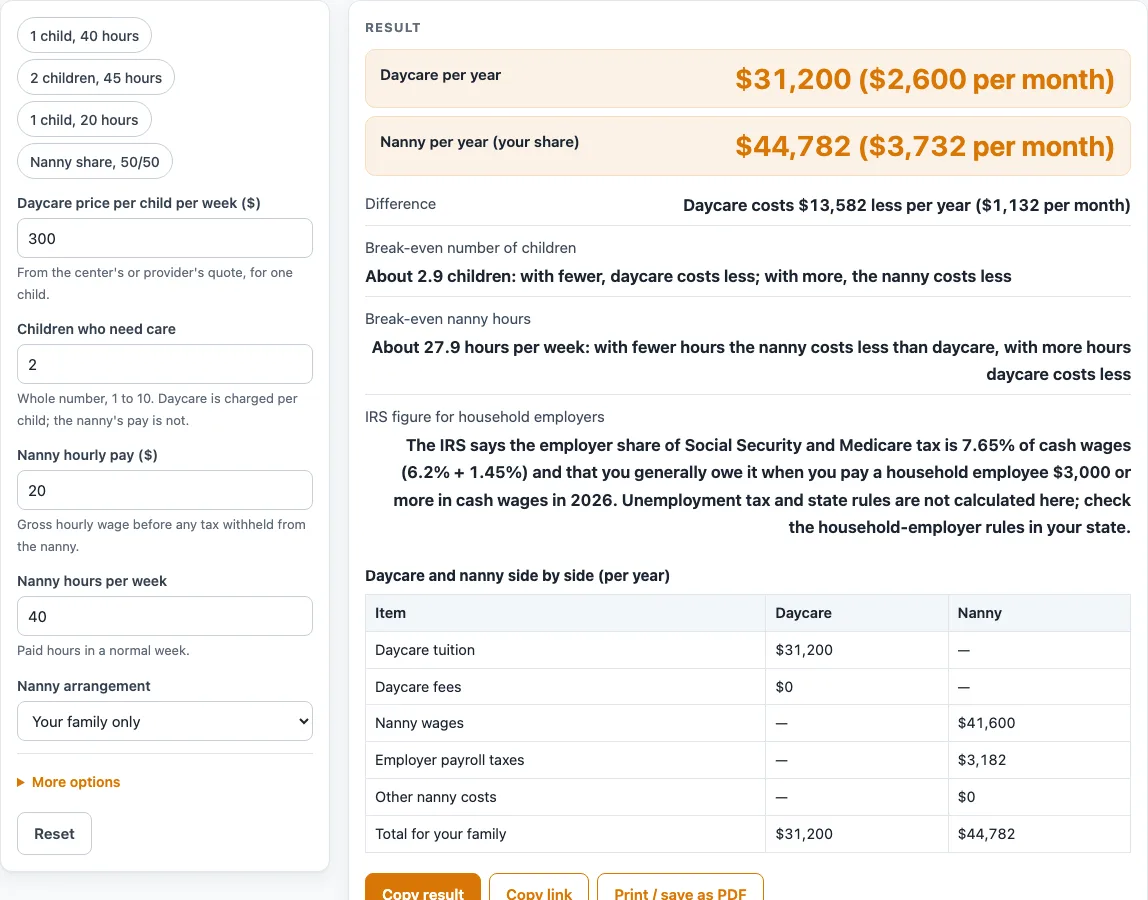
- Enter the “Daycare price per child per week ($)”, the “Children who need care” (1 to 10) and, under more options, the “Daycare weeks you pay per year” (up to 52, default 52).
- Add “Daycare fees per child per year ($)”, such as registration or supplies. Leave it at 0 if there are none.
- Enter “Nanny hourly pay ($)” and “Nanny hours per week” (up to 100).
- Enter “Weeks the nanny works” (default 50) and “Paid weeks off” (default 2). Together they cannot exceed 52.
- Check “Employer payroll taxes (% of wages)”. It starts at 7.65%. Change it to add your own estimate of other employer taxes, or set it to 0.
- Enter “Other nanny costs per year ($)”, such as a payroll service, insurance or meals.
- If you share the nanny, set “Nanny arrangement” to “Shared with another family” and enter “Your share of the nanny’s cost (%)”.
- Read the results: daycare per year, nanny per year, the difference, the break-even number of children and the break-even nanny hours. Read any warning before you rely on the numbers.
- Review the side-by-side table, which lists daycare tuition, daycare fees, nanny wages, employer payroll taxes, other costs and the totals. You can copy or print the result.
Warnings appear when yearly wages are under $3,000 while a payroll percent is entered, when the percent is below 7.65%, when nanny hours are over 60, and when a shared split is 100%. You can also start from a preset, such as “1 child, 40 hours” or “Nanny share, 50/50”.
How is daycare cost per year worked out?
Daycare cost per year is the weekly price times the weeks paid times the number of children, plus the yearly fees per child times the number of children. In the default example, $300 a week for 2 children for 52 weeks gives $31,200.
How is nanny cost per year worked out?
Nanny wages equal hourly pay times hours per week times the sum of weeks worked and paid weeks off. Payroll taxes equal wages times the payroll percent, and the nanny total equals wages plus payroll taxes plus other costs. In the default example, $20 an hour for 40 hours over 52 paid weeks gives $41,600 in wages. Payroll taxes at 7.65% add $3,182, for a nanny total of $44,782.
What do the break-even numbers mean?
Break-even children equals your nanny cost divided by the daycare cost per child, where daycare cost per child is the weekly price times weeks paid plus fees. With fewer children, daycare costs less. With more children, the nanny costs less. The default example gives 2.9 children.
Break-even hours equals daycare cost minus your share of other costs, divided by hourly pay times paid weeks times (1 + payroll percent) times your share. The default example gives 27.9 hours. The result shows “None” when other costs alone are higher than the daycare cost.
How does the nanny share setting work?
Set “Nanny arrangement” to “Shared with another family” and enter your share in percent. Your nanny cost is the nanny total multiplied by your share, and the table shows the other family’s portion. With the default numbers and a 50/50 split, your share is $22,391, which is $8,809 less per year than daycare at $31,200.
What is the payroll percent?
The payroll percent starts at 7.65%, which is the employer share of Social Security and Medicare that the IRS publishes (6.2% plus 1.45% of cash wages). IRS Tax Topic 756, reviewed 24 September 2026, says you generally owe that employer share when you pay a household employee $3,000 or more in cash wages in 2026. The calculator shows this as published information. Unemployment tax, state rules, overtime and tax credits are not calculated, so check the household-employer rules in your state.
Sources (checked 15 October 2026): irs.gov
Worked examples
| Input | Result |
|---|---|
| Daycare $300 per week for 2 child(ren), nanny $20.00 an hour for 40 hours | Daycare $31,200 per year, nanny $44,782 per year |
| Daycare $300 per week for 2 child(ren), nanny $20.00 an hour for 40 hours | Daycare $31,200 per year, nanny $22,391 per year |
| Daycare $300 per week for 1 child(ren), nanny $20.00 an hour for 20 hours | Daycare $15,600 per year, nanny $22,800 per year |
| Daycare $450 per week for 1 child(ren), nanny $18.00 an hour for 30 hours | Daycare $23,400 per year, nanny $30,228 per year |
Calculated by the tool above; open it with the same values to see each step.
Frequently asked questions
Is a nanny cheaper than daycare for one child?
It depends on your numbers. In one example with 1 child, a nanny working 20 hours a week at $20 an hour, 0% payroll taxes and $2,000 in other costs, the nanny costs $22,800 and daycare costs $15,600. The break-even is 13.1 hours.
Does the calculator include unemployment tax?
No. Unemployment tax, state rules, overtime and tax credits are not calculated. Check the household-employer rules in your state.
What does “None” mean in the break-even hours?
“None” appears when your other yearly costs alone are higher than the daycare cost. In that case, no number of nanny hours makes the two options equal.
Can I use it when a nanny is shared with another family?
Yes. Set “Nanny arrangement” to “Shared with another family” and enter your share in percent. The nanny total is multiplied by your share, and the table shows the other family’s portion.
Does the calculator need any personal details?
No names or personal details are entered. The result is a planning estimate calculated from the numbers you enter.
Why does a warning about $3,000 appear?
A warning appears when yearly wages are under $3,000 while a payroll percent is entered. IRS Tax Topic 756 says the employer share of Social Security and Medicare generally applies when cash wages reach $3,000 or more in 2026.
Related tools
- Daycare Cost Calculator: Use it to look at daycare costs alone before comparing them with a nanny.
- Daycare Contract Template: Use it to build a printable contract sheet for the terms you agree on.
- Daycare Enrollment Form: Use it to build a printable enrollment sheet for a new child.
- Emergency Contact Form: Use it to build a printable sheet listing emergency contacts.
- Attendance Sheet: Use it to build a printable sheet for recording daily attendance.
- Field Trip Permission Slip: Use it to build a printable permission slip for an outing.
- Media Release Form (Sample): Use it to build a sample printable form for permission to use photos or video.
- Parent Contact Log: Use it to build a printable log of contact with families.